If your dog finishes a dental stick in three minutes and then stares at you for the next hour, this page is for you.
"Long-lasting" means different things to different dogs. A Springer gets through a Yaker in 40 minutes. A Lurcher takes nearly an hour. Your Labrador might halve those times.
For this guide, "long-lasting" means 30 minutes or more for a medium-sized dog with moderate chewing power.
Our top pick
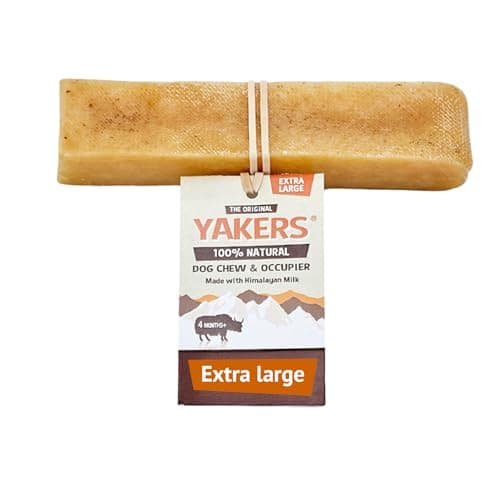
Yakers Yakers Original Himalayan Dog Chew XL · ~£8.50
Best overall long-lasting natural chew for 30–60 minutes of quiet.
Affiliate note: Dog Product Reviews is reader-supported. If you buy through some links on this site, we may earn an affiliate commission. That helps keep the site running, but it does not change how products are selected, ranked or criticised. As an Amazon Associate I earn from qualifying purchases.
What actually matters here
Duration — 30+ minutes for a medium dog with moderate chewing power is the threshold for this guide.
Digestibility — fully digestible chews only. No rawhide, no mystery ingredients.
Tooth safety — very hard chews (antlers) carry fracture risk. The sweet spot is medium-to-hard.
Single ingredient where possible — Yakers (pressed milk), JR Pure Sticks (100% beef), bully sticks (bull pizzle).
Value per minute of chewing, not just cost per chew.
Antler chews: the controversial pick
Antler chews are genuinely long-lasting (hours), don't smell, and don't make a mess. But most UK vets now caution against them — the British Veterinary Dental Association warns they're the most common cause of slab fractures in dogs. A slab fracture usually means extraction at £500+.
If you choose antlers, buy whole staghorn (softer than split), supervise every session, and stop if your dog bites down hard rather than gnawing.
The microwave trick for Yakers
When the Yaker wears down to 3–4cm: place on a microwave-safe plate, microwave on high for 30–60 seconds, it puffs up to 2–3x its size, let it cool for 2 minutes, then give it as a crunchy treat. Zero waste, no choking hazard.
Matching chew hardness to your dog
Gentle gnawers (small breeds, seniors): JR Pure Sticks, Whimzees. Moderate chewers (most medium breeds): Yakers Medium or Large. Strong chewers (Labs, Staffies, Spaniels): Yakers XL. Power chewers: frozen stuffed KONG Extreme — safer than any hard chew.
Quick questions before you buy
Are Yakers safe for puppies?
Yakers recommend their chews for dogs over 4 months old. Younger puppies should stick to softer chews like frozen KONGs with puppy-safe fillings.
How often should I give a long-lasting chew?
Two to three times per week for entertainment chews. Factor calories into food allowance — a Yaker XL is roughly 80–100 calories.
Why it made the list: Pressed yak and cow milk — nothing else. Wears down gradually rather than breaking into chunks. Microwave the nub for a puffed cheese treat — zero waste, zero choking risk from the last piece.
Main drawback: Messy on soft floors. ~£8.50 per XL chew adds up. Dogs with snapping chew styles may break pieces off.
Typical price band: ££
Pros
100% natural single-ingredient chew.
Genuinely lasts 30–60 minutes.
Digestible — no blockage risk.
Microwave trick eliminates small-piece hazard.
Available from Small to XL.
Cons
Messy on carpets — cheese residue is real.
Cost adds up for daily use.
Supervise power chewers who crack rather than gnaw.
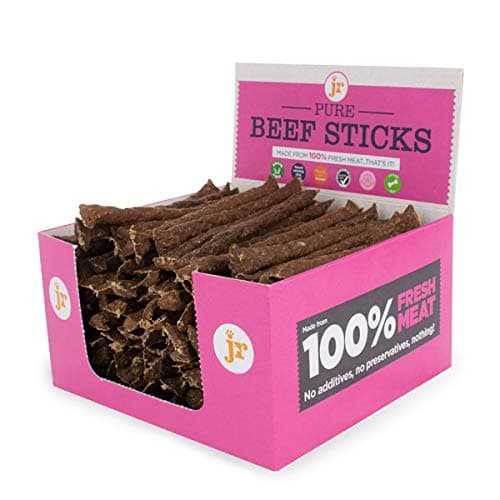
Around ~£13 (1kg) · check Amazon for current price
Why it made the list: 100% beef, single ingredient, air-dried. A 1kg bag gives a lot of chewing for £13. Each stick lasts 15–30 minutes. Fully digestible with no blockage risk.
Main drawback: They smell strongly — outdoor use or hard floors recommended. Not as long-lasting as a Yaker. Sticks vary in size within the bag.
Typical price band: £
Pros
Genuine single ingredient — 100% beef.
1kg bag is excellent value.
Air-dried preserves nutrients without chemicals.
Fully digestible.
Cons
Strong smell — your living room will know about it.
Yakers recommend their chews for dogs over 4 months old. Younger puppies should stick to softer chews like frozen KONGs with puppy-safe fillings.
How often should I give a long-lasting chew?
Two to three times per week for entertainment chews. Factor calories into food allowance — a Yaker XL is roughly 80–100 calories.
My dog finishes a Yaker in ten minutes. Is that normal?
For a large, strong chewer — yes. Try the XL size, or switch to a frozen stuffed KONG which forces slow licking.
Are bully sticks safe?
Yes — natural, single-ingredient, fully digestible. They last 15–45 minutes. The downside: they smell terrible.
What's the safest long-lasting chew overall?
For the best balance of safety, duration and digestibility: Yakers Himalayan Chew. Natural ingredients, no fracture risk for gnawers, the microwave trick eliminates the small-piece hazard.
Which dog chews last the longest?
Yak milk chews and split antlers last longest — often days or weeks. However split antlers are a known tooth-fracture risk. Yak milk is the lowest-risk long-lasting option. Frozen stuffed KONGs can also extend chew time significantly.
What do vets recommend for dogs to chew on?
Vets recommend rubber toys like KONG, yak-milk chews, natural cartilage, and VOHC-accredited dental chews. Avoid anything harder than the dog's own teeth — if you cannot dent it with a fingernail, it is a fracture risk.
What are the safe long lasting dog chews UK?
Yak milk chews, cartilage strips, beef trachea, pizzles and rabbit ears are the lowest-risk long-lasting chews in the UK. Avoid whole bones, cooked bones, rawhide, antlers and hooves — these cause most of the chew-related vet visits.
What do professional dog trainers use for treats?
Most UK trainers use high-value small soft treats for training — freeze-dried liver, cooked chicken, dried fish, or commercial options like Lily's Kitchen and Fish4Dogs. Treats are broken into pea-sized pieces so the dog gets many rewards per session.
What can a dog chew on for hours?
A frozen stuffed KONG, a yak milk chew, or a cartilage strip will keep most dogs occupied for 30 minutes to a few hours. For longer duration, rotate a few enrichment toys rather than relying on one very hard chew that risks tooth fractures.